According to the Central Pollution Control Board's mobile application SAMEER, the city recorded an air quality index of 168, which falls in the 'moderate' category, much better than Monday's AQI of 221, which falls in the 'poor' category.

Despite legal deterrent in place to discourage people from doing so, by dusk, residents in many neighborhoods, including some areas in south Delhi and northwest Delhi, had started bursting crackers.

Hailstorms were reported at various parts of the national capital including Palam, Chilpighat and Ayanagar, the IMD said.

The air quality in the capital has remained very poor or severe on most of the days in November so far.
You can have a traditional Diwali celebration with your family at these special spots.

Despite the national capital recording its best air quality on Diwali day in eight years, pollution levels may rise due to low night temperatures and sporadic burning of firecrackers though there is a ban on their manufacture, storage, sale and use within the city.

According to Central Pollution Control Board's (CPCB) Sameer app, the city's air quality index (AQI) stood at 449 in the severe category at 8 am on Saturday. It was 462 on Friday.

The air quality index of neighbouring areas of Faridabad, Ghaziabad, Gurgaon and Noida was recorded at 312, 368, 301 and 357, respectively.

According to the Central Pollution Control Board (CPCB), the 24-hour average concentration of lung-damaging fine particles known as PM2.5 in Delhi-NCR shot up from 243 micrograms per cubic metre at 6 pm on Thursday (Diwali day) to 410 micrograms per cubic metre at 9 am on Friday, around seven times the safe limit of 60 micrograms per cubic metre.

The nationwide 'Janta Curfew' followed by the 21-day lockdown to combat the coronavirus outbreak have led to a significant reduction in pollution in the country, with 91 cities recording air quality in the 'good' and 'satisfactory' category on March 29, a Central Pollution Control Board report has stated. Travel restrictions and the closure of industries have helped reduce the pollution level, it said.
Debates on changing the name of India to Bharat continue to spark a crisis of identity without answering moot questions that stare us in the face. Ramesh Menon asks a few of those questions that do not have easy answers.

Green think tank Centre for Science and Environment (CSE) said the ongoing smog episode is a public health emergency.

Delhi's overall air quality index (AQI) stood at 463 at 11.30 am, according to the System of Air Quality and Weather Forecasting and Research (SAFAR).

A thin layer of toxic haze hung over Delhi in the morning and the overall air quality index stood at 313 at 9 am. It continued its upward trend and was recorded at 337 at 1 pm.

Skies over Delhi hung heavy with smoke and its air quality inched towards "severe" category on Diwali night as people burst firecrackers in a blatant disregard to the government's ban against it, imposed amid an increase in the contribution from farm fires.
This is the third time this season, after December 8 and January 1, that visibility has dropped to zero metres in the city.

Delhi's air quality was again in the severe category with the 24-hour average AQI recorded at 403 after remaining in the 'very poor' category till Tuesday morning, when the AQI was recorded at 396.

'If you keep on irritating the body by allowing all kinds of pollutants to get into it, the body cells are going to get irritated and cancer will come.'

The air quality in the national capital remained poor for the sixth consecutive day on Monday with stubble burning accounting for seven per cent of the capital's PM2.5 pollution.

Colourful lights illuminated buildings and earthen lamps dotted houses as people across the country celebrated Diwali with pomp on Monday after two years of muted festivities due to the pandemic.

The city's air quality index stood at 385 at 9.05 am, while that of Noida, Gurgaon and Greater Noida was recorded at 406, 363, 296, respectively.

22 of the 37 air quality monitoring stations across Delhi recorded the air quality in the severe category on Thursday morning.
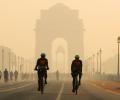
"The overall Delhi's Air Quality Index is in the very poor category with few Delhi locations entering at higher zone but that will be short lived. This is mainly because the extremely calm local surface winds which were prevailing yesterday are likely to increase slightly and may further pick-up by Oct 26," SAFAR said.
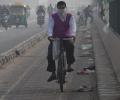
With seasonal crop residue burning, coupled with vehicle emissions, calm winds and low temperatures persisting for some time, the thick layer of toxic smog has hovered over the national capital.

The dip in the air quality can be attributed to low wind speed and temperatures which allowed accumulation of pollutants.

Low temperature -- Delhi recorded a minimum of 13.5 degrees Celsius on Tuesday, the season's lowest so far -- allowed accumulation of pollutants, said Mahesh Palawat, vice president (meteorology and climate change), Skymet Weather.

Delhi recorded an air quality index of 315 at 11:10 am. The last time the air quality hit such a poor level was in February.

The official data maintained by the Centre-run System of Air Quality and Weather Forecasting And Research put the condition at severely polluted. The Particulate Matter 2.5 level was recorded at 146 while the PM 10 was at 233 in New Delhi.
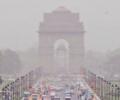
Rediff Labs has analysed Delhi region's air quality through its product real-time air quality analyser

The central government's Air Quality Early Warning System for Delhi said a significant increase in the number of "fire points" was observed over Punjab (around 3,000), Haryana and Uttar Pradesh on Wednesday, which is likely to impact the air quality of Delhi-NCR and other parts of northwest India.

The air quality in Delhi remained poor Sunday with drop in wind speed even as authorities predicted further fall in air quality index of the national capital in the coming days.

The central government's Air Quality Early Warning System for Delhi said a "significant improvement in air quality is not likely" owing to slow wind speed, particularly during night time, and contribution from farm fires.

Experts said while meteorological conditions were "moderately" favourable for dispersion of pollutants, a "very high" number of farm fires in Punjab was the primary reason for "severe" air quality.
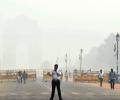
The overall AQI deteriorated further and touched the 268 mark, which falls in the poor category.

On Thursday, the overall AQI in Delhi was 312 around 8:30 in the morning.

It is believed that the crop residue burning in the nearby states of Punjab and Haryana are contributing to polluting the air.

According to senior IMD scientist Kuldeep Srivastava, clear sky or absence of clouds allows sun rays to reach the ground, warming up the air close to the ground which lifts up and clears the pollutants.

A CPCB official said a number of factors were responsible for the deteriorating air quality, including vehicular pollution, construction activities and meteorological factors.

The overall air quality index was recorded at 426 which falls in the 'severe' category, according to data by the Central Pollution Control Board.

The rotation policy followed by the BCCI and the travel route for the visiting team forced the BCCI to schedule the first match of the tour in Delhi
 © 2026 Rediff.com - Investor Information - Advertise with us - Disclaimer - Privacy Policy - Sitemap - Feedback - About us - Terms of use - Grievances